
Coffee for Hotel Breakfast: Why Guatemalan Coffee Makes Better Hospitality Service
28. mai 2026 · 12 min lesing
Coffee for Hotel Breakfast: Why Guatemalan Coffee Makes Better Hospitality Service
Hotel breakfast coffee has a difficult job. It has to please the guest who wants one quiet cup before a meeting, the traveller who usually drinks pour-over coffee at home, the family looking for comfort, and the hospitality manager who needs consistency across a busy service window. Too often, that job gets handed to anonymous dark roast because it feels safe.
But “safe” is not the same as memorable. In modern specialty coffee culture, guests in the US, UK, Europe, and Nordic markets increasingly know what a clean, traceable cup can taste like. They may not expect a full café experience at breakfast, but they notice when coffee tastes flat, burnt, stale, or thin.
This is where Guatemalan coffee becomes genuinely useful. Not as a decorative origin claim, but as a practical hospitality choice: sweet enough for broad appeal, structured enough for batch brew, and distinctive enough to tell a real story.
Quick answer: is Guatemalan coffee good for hotel breakfast?
Yes. Guatemalan coffee is an excellent choice for hotel breakfast and hospitality service because it often combines chocolate-like sweetness, medium-to-full body, clean acidity, and a calm, balanced finish. That profile works well in batch brew, thermal servers, and breakfast pairings because it stays approachable while still feeling like specialty coffee.
For hotels, cafés, offices, and restaurants, the advantage is not just flavour. A traceable single-origin coffee from Guatemala gives staff a simple story to share: country, region, farm or cooperative, process, roast, and tasting notes. That turns breakfast coffee from a generic utility into part of the guest experience.
The market reality: guests now recognise better coffee
Europe is not a niche coffee market. CBI describes Europe as the world’s largest green coffee market and notes that Europe accounted for 30.7% of global coffee consumption in 2023/2024, while market value is expected to grow through premiumisation (CBI demand report). In plain English: people may not drink dramatically more coffee every year, but many are paying more attention to quality, origin, convenience, and trust.
CBI also reports that European specialty coffee demand is growing, partly through out-of-home consumption, and that coffee shops help introduce consumers to new varieties, taste profiles, and origin stories (CBI specialty coffee report). That matters for hospitality. A guest who has learned to ask for Ethiopian filter coffee, Colombian espresso, or Kenyan batch brew in a city café brings those expectations into hotels, offices, and event spaces.
The lesson is not that every hotel must become a competition café. It is simpler: the baseline has moved. Better coffee no longer feels like an extravagant extra. For many international guests, it is part of the quality signal of the whole stay.
Why Guatemala fits the breakfast table
Guatemala is one of the easiest specialty origins to recommend for a mixed audience. Compared with Ethiopia, it is usually less floral and less tea-like. Compared with Kenya, it is typically less sharply acidic. Compared with Brazil, it often brings more highland structure and citrus lift. Compared with Colombia, it can share caramel sweetness while adding cocoa, spice, and a distinctive Central American clarity.
That balance is exactly what breakfast service needs.
A hotel coffee should not demand too much from the guest at 7:15 in the morning. It should taste sweet, clean, and comfortable in a mug. But it also should not disappear beside food or milk. Many washed Guatemalan coffees sit in that sweet spot: cocoa and brown sugar for comfort, orange or red apple for freshness, and enough body to feel satisfying.
When we say body, we mean texture: the weight or mouthfeel of the coffee. A fuller-bodied cup feels rounded and present, not watery. When we say acidity, we mean brightness, not sourness. In a good Guatemalan cup, acidity may remind you of orange, apple, or plum rather than lemon juice.
From third-wave café to hotel breakfast: what changes?
A specialty café can adjust one pour-over coffee at a time. Hotel breakfast cannot. Hospitality coffee has to survive scale: larger brew baskets, thermal servers, staff handovers, and guests arriving in waves.
That changes the buying criteria. A coffee that dazzles in a delicate pour-over may not be the best choice for a buffet or breakfast room. A very light Ethiopian natural can smell beautiful but feel divisive beside eggs, yoghurt, fruit, and toast. A powerful Kenyan can be thrilling for enthusiasts but too intense for a broad guest mix. A dark commodity blend may be easy, but it often sacrifices sweetness and origin character.
Guatemalan coffee gives hospitality teams another route: recognisably specialty, but not fragile. In a well-roasted batch brew, it can hold sweetness for a full service period, pair with food, and give staff language that sounds human rather than technical: “This is a single-origin Guatemalan coffee with notes of cocoa, orange, and toasted almond.”
That sentence is enough. It tells the guest there is care behind the cup without making breakfast feel like a lecture.
Traceability is part of the service, not just the ethics page
Specialty buyers increasingly care about traceability because it connects quality, sustainability, and accountability. CBI notes that specialty coffee often includes detailed origin information such as the farm or cooperative, growing conditions, and personal producer stories, and that consumers are more interested in how and by whom coffee is grown (CBI specialty coffee report).
For a hotel, traceability is useful in three ways.
First, it helps purchasing teams know what they are buying. “100% Arabica” is not enough information. Region, process, roast date, and producer relationship say much more about quality.
Second, it helps staff speak confidently. A server does not need to memorise a farm biography. They only need a clear, true version of the story: Guatemala, highland Arabica, washed process, direct relationship, roasted for clean sweetness.
Third, it helps guests trust the experience. In a premium hotel, every detail communicates values: the bread, the linen, the ceramics, the lighting, the local produce. Coffee should not be the anonymous exception.
At Kapalaj, this is central to how we think about direct trade coffee. Direct trade means a shorter, more transparent relationship between the people who grow coffee and the people who roast or sell it. It is not a universal certification, so the details matter. Ask who the relationship is with, what information is traceable, and how quality is evaluated.
Guatemala’s regional diversity gives buyers options
Guatemala is not one flavour. The country’s coffee regions are shaped by altitude, rainfall, volcanic soils, temperature, and local processing traditions. Guatemalan Coffees, the origin platform from Anacafé, highlights regional profiles such as Acatenango Valley, Antigua, Atitlán, Cobán, Fraijanes, Highland Huehue, New Oriente, and Volcanic San Marcos, and explains that microclimate and growing conditions have a major impact on cup taste (Guatemalan Coffees).
For hospitality, you do not need to turn the breakfast menu into an origin map. But knowing the broad patterns helps you choose well.
- Antigua or Acatenango can be ideal when you want cocoa, spice, and composed sweetness.
- Huehuetenango often suits teams looking for more fruit clarity, citrus, and high-grown structure.
- Atitlán can bring freshness and lift, especially in filter-focused service.
- Cobán may offer softer aromatic qualities, depending on lot and roast.
These are tendencies, not promises. The final cup depends on variety, harvest, processing, storage, roasting, grinding, water, and brewing. Still, regional information gives buyers and educators a better starting point than “medium roast house coffee.”
A practical hospitality brew profile
The Specialty Coffee Association publishes standards and protocols for evaluating and preparing coffee, which is one reason terms like brew ratio, extraction, and cupping are widely shared across the specialty world (SCA coffee standards). You do not need a lab to improve hotel coffee, but you do need repeatable habits.
Here is a practical starting point for Guatemalan coffee in batch brew or high-volume breakfast service:
| Service variable | Recommended starting point | Why it matters |
|---|---|---|
| Roast style | Light-medium to medium | Preserves sweetness and origin character without tasting thin |
| Brew ratio | 60g coffee per litre of water | A balanced baseline for filter-style service |
| Grind | Medium, adjusted to brew time | Too fine tastes bitter; too coarse tastes weak or hollow |
| Water | Clean, filtered, not aggressively hard | Poor water can flatten sweetness or exaggerate bitterness |
| Holding time | Ideally under 60 minutes | Coffee loses aroma and clarity as it sits |
| Staff check | Taste the first brew of the day | A 20-second check prevents a full service of bad coffee |
If the coffee tastes bitter and drying, grind slightly coarser, reduce dose a little, or check whether the brew basket is overflowing. If it tastes weak and sharp, grind finer or increase dose. If it tastes dull no matter what you do, check water quality, roast freshness, and how long the coffee has been held hot.
The goal is not perfection. The goal is a repeatable cup that tastes sweet, clean, and intentional at 7:00, 8:30, and 10:00.
Pairing Guatemalan coffee with breakfast food
One reason Guatemalan coffee works in hospitality is that it plays well with breakfast flavours beyond generic pastries.
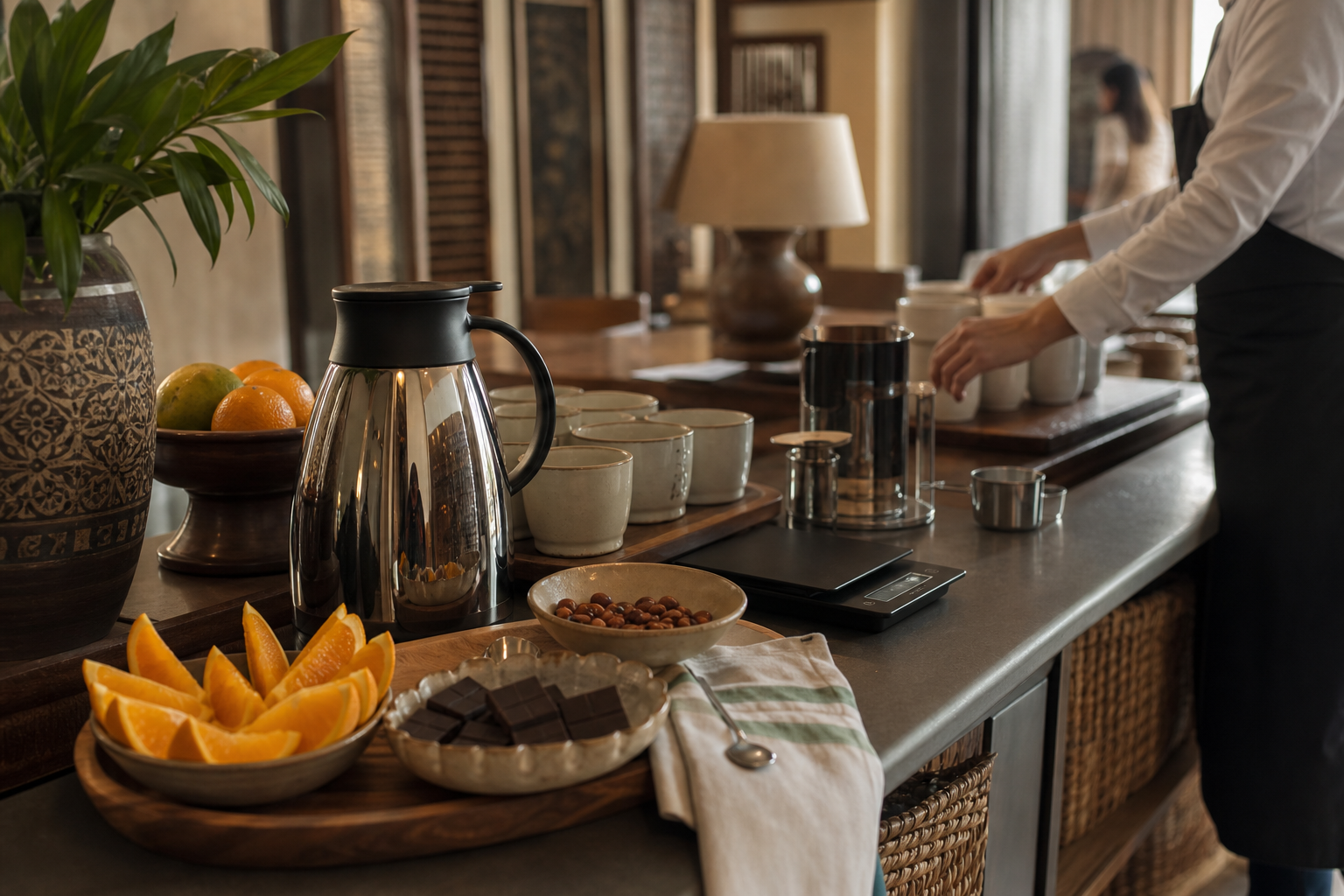
A cocoa-and-orange Guatemalan filter coffee pairs naturally with sourdough toast, almond butter, granola, yoghurt, berries, and dark chocolate. A deeper Antigua-style profile can sit beautifully beside cinnamon, roasted nuts, banana bread, or a warm oat bowl. A brighter Huehuetenango can lift fresh fruit, citrus, soft cheeses, and lighter breakfast plates.
For hotels and cafés, this opens a simple menu opportunity: do not just list “coffee.” List a short flavour cue.
“Today’s breakfast coffee: single-origin Guatemala, brewed for notes of cocoa, orange, and toasted almond.”
That line helps guests taste more. It also signals care without adding operational complexity.
What to ask before buying coffee for hospitality
If you are choosing Guatemalan coffee for a hotel, office, restaurant, or event space, ask better questions than “Is it strong?” Strength often just means concentration or roast intensity. A better coffee brief looks like this:
- Who will drink it? International tourists, business guests, local café regulars, conference attendees, or office teams?
- How will it be brewed? Batch brew, espresso, automatic machine, French press, or manual pour-over coffee for premium service?
- Will it be served with milk? If yes, choose enough body and sweetness to stay present.
- How long will it sit? Choose a roast and brew system that keep the cup clean during realistic service.
- What story can staff tell in one sentence? If nobody can explain the coffee, the origin value is being wasted.
- Is the coffee traceable? Look for region, process, producer or cooperative information, harvest context, and roast date.
For a broad hospitality setting, the safest specialty profile is usually not the wildest coffee on the cupping table. It is the coffee that still tastes good to the tenth guest, not only the first judge.
FAQ: Guatemalan coffee for hotels and breakfast service
Is Guatemalan coffee too acidic for hotel guests?
Usually no. Good Guatemalan coffee often has clean, fruit-like acidity rather than sharp sourness. If guests find it too bright, the issue may be roast level, grind size, water, or under-extraction rather than the origin itself.
Is single-origin coffee practical for batch brew?
Yes, if the coffee is selected and roasted for the brew method. Single-origin coffee does not have to mean delicate or difficult. Many Guatemalan lots are structured enough for batch brew while still offering a clear origin story.
What tasting notes should I expect from Guatemalan coffee?
Common notes include cocoa, caramel, brown sugar, orange, red apple, plum, almond, and gentle spice. The exact profile depends on region, variety, process, roast, and brewing.
How is Guatemalan coffee different from Colombian coffee?
Both can be sweet, approachable, and versatile. Colombian coffee often leans caramel, red fruit, and balanced acidity, while Guatemalan coffee frequently brings cocoa, citrus, spice, and highland structure. The difference is subtle but useful when planning a menu.
Should hotels choose espresso roast or filter roast for breakfast coffee?
For batch brew and breakfast filter service, choose a roast designed for filter or omni-brew rather than a very dark espresso roast. You want sweetness, body, and clarity, not smoky bitterness.
The real upgrade: make coffee feel intentional
The best hotel breakfast coffee is not necessarily the rarest lot or the most experimental process. It is coffee that feels chosen. It tastes good with food. It remains clear in service. It gives staff a simple story. It respects the guest who cares about specialty coffee without alienating the guest who simply wants a comforting morning cup.
Guatemalan coffee is well suited to that role because it can be both generous and precise. It can carry the familiar warmth of chocolate and toasted nuts while still showing the brightness, traceability, and origin character that modern coffee drinkers value.
If your breakfast service, office coffee, or hospitality menu still treats coffee as an afterthought, Guatemala is a smart place to begin.
Explore Kapalaj’s traceable Guatemalan coffees at /en/butikk, learn more about our origin work at /en/opprinnelse, or read our guide to traceability in specialty coffee before choosing beans for your next service.